So its been a long time NO post... Mainly because of the world of Tumblr etc, but I'll be back. This post is all about my new years resolutions! So here goes:
1.) Inspired by the fabulous blog of Sam Bush, I'm going to take up the 365 day photo challenge. A photo a day, for a year, on a separate blog.
2.) This is 50/50 still BUT I want to start a second blog, a bike blog after taking to reading a lot of bike blogs over the past year! I'm not sure whats going to be so special about it, but we will see where that goes!
I'm sure I've got more... I'll add them if I think some up! ;-)
Wednesday, 21 December 2011

Wednesday, 9 February 2011
Two Ideas...
In my origional project proposal I stated how I wanted to create a series of work, which created a critisism of societies attitude towards recycling and waste. My aim was to show a different side but also to teach myself about the matter through creating the work. After finding a set of maps on the enviroment agency which highlight areas near your postcode that are on record as being landfill sites I made the decision that these sites would be the location of my images. After further research of the areas in London I started taking photographs and finding more out about the sites - one of my initial questions was 'Where does London's waste go?' after finding that no one in my flat understood the ideas of recycling or reducing waste - something which I am not use to. After asking this question I made the decision to just look at the landfill sites in London - these sites being the site of Surrey Quays shopping centre, The O2 Arena in Greenwich and Wapping/ Shadwell. After photographing these areas I discovered that they were in fact the old docks from the 19th Century. This sparked more research into the docks and their use.
So far my research into the docks and to the disposal of waste has been: watching 'Peter Ackroyd's Thames' (2008), Patrick Keiller's 'London' (1992) and 'Robinson in Space' (1997), reading Black Dog Publishing's 'Recycle: The Essential Guide' which includes a number of case studies on recycling and waste management and also walking around and looking at the streets around the areas of the landfill sites.
From my research into Recycling I found a lot out about the different types of recycling, waste sites and also about ideas on how and what should be done to tackle the problem - a problem which many do not reguard as a problem. Through reading the preface and intordutcion of the book I learnt how many industiralised areas like shopping centres, golf courses and childrens areas are shaped by landfill if they can. To me this came as a shock but after looking at the idea more I'd quite like to create images which form a a neutral look on the situiation.
What I've come to understand, through this research and finding out that the park and play area that me and my two sisters grew up on is in fact a landfill site (from 1950 to 1962 (see this link)) is that as much as the land was filled in the first place at least it is being re-used and re-developed. At first I had a very negative view on the situation but now I have an understanding. It is not that I want to critisise the actual landfill sites which have been built on but instead to either highlight or to crisisise the sites of the landfill and to show the audience of my work what they are doing by littering and no recycling is creating more oppertunity for this to happen again.
Ramble over, two basic visual ideas are:
1.) Create an aerial view of Surrey docks out of found recycling and waste on the shopping centre site. Disgusing it with elements of nature - as rubbish is often hidden in these places. Personally this is an idea I want to go a head with but I feel as though it doesn't answer the brief of 'Modernism'.
2.) Create 3 images which highlight the area at home where the landfill site changed into the park complex for children and their parents - eg. capture these areas in a modernist fashion - playgrounds, golf courses and industrial areas like shopping centres.
Ramble two over... need to develop my two 120 films from the weekend. I'll scan in soon and post!
So far my research into the docks and to the disposal of waste has been: watching 'Peter Ackroyd's Thames' (2008), Patrick Keiller's 'London' (1992) and 'Robinson in Space' (1997), reading Black Dog Publishing's 'Recycle: The Essential Guide' which includes a number of case studies on recycling and waste management and also walking around and looking at the streets around the areas of the landfill sites.
From my research into Recycling I found a lot out about the different types of recycling, waste sites and also about ideas on how and what should be done to tackle the problem - a problem which many do not reguard as a problem. Through reading the preface and intordutcion of the book I learnt how many industiralised areas like shopping centres, golf courses and childrens areas are shaped by landfill if they can. To me this came as a shock but after looking at the idea more I'd quite like to create images which form a a neutral look on the situiation.
What I've come to understand, through this research and finding out that the park and play area that me and my two sisters grew up on is in fact a landfill site (from 1950 to 1962 (see this link)) is that as much as the land was filled in the first place at least it is being re-used and re-developed. At first I had a very negative view on the situation but now I have an understanding. It is not that I want to critisise the actual landfill sites which have been built on but instead to either highlight or to crisisise the sites of the landfill and to show the audience of my work what they are doing by littering and no recycling is creating more oppertunity for this to happen again.
Ramble over, two basic visual ideas are:
1.) Create an aerial view of Surrey docks out of found recycling and waste on the shopping centre site. Disgusing it with elements of nature - as rubbish is often hidden in these places. Personally this is an idea I want to go a head with but I feel as though it doesn't answer the brief of 'Modernism'.
2.) Create 3 images which highlight the area at home where the landfill site changed into the park complex for children and their parents - eg. capture these areas in a modernist fashion - playgrounds, golf courses and industrial areas like shopping centres.
Ramble two over... need to develop my two 120 films from the weekend. I'll scan in soon and post!
British Rubbish: Sue Webster & Tim Noble

Dirty White Trash (With Gulls), 1998 - Webster & Noble
Webster & Noble are an english colaboration based in London whose work is collected by Charles Saatchi. They met on a Fine Art degree course and both graduated from University of Nottingham. Their work looks at taking objects of an ordinary nataure to create self-portraits and sculptures of detail and beauty. The work from their body of work 'Britist Rubbish' is the work which is most relevant to mine but other bodies of their work does have links.
The image above of their 'Dirty White Trash' sculpture is one of the best known work from this series. The basis of the idea is the way the disguarded waste, scrap metal and in some cases the taxidermy animals are transformed into recognisable images. All the items which create the sculptures is all collected from around London and then pieced together. The transformation of the waste into recognisable projection comes from the idea of perceptual pshycology, which is a form of evalualtion for pshycological patients. Before creating the work they were both aware of this process of how people evaluate abstract forms.
From the way the image has been composed the first thing you see is the shadow at the back so I don't think it has the same effect as it would if you saw it in a gallery. When I first found this image I thought that it was all done on Photoshop through image manipulation but u pon further research found that it was in fact a sculpture. Personally I think this work is a strong example of how artists can reuse objects to recycle in their own way.
In the way of this image itself I think it is one of the most sucsessful. It is a self-portrait of Noble and Webster and reflects the time they spent together, not only as a couple but also as a colaberation. Collecting and creating the works of art that are part of their 'British Rubbish'. The rubbish they collected for the piece consists of many different elements of municipal waste and recycling - reflecting the idea of the waste in London but also reflecting their ideas of how people evaluate form. Transforming not only the figure of something which people disguard and forget about into something of detail and beauty but also an attempt to transform peoples views on the ideas of waste and waste disposal.
From this work I want to try out the idea of manipulating certian factors in my images - like the found waste and objects that I find when shooting. Manipulating the images to create something recognisable. Perhaps looking at discreatly creating the layout of the old docks at Surrey Quays within my images.
13/02/11
Whilst at the science museum looking at their 'Pshycoanalysis: The Unconsious in Everyday Life' exhibition and I came across another Noble & Webster sculpture. What I was saying in the text before about when you see it in a gallery you just stare at the actual sculpture and not at the shadow is exactly how it happens. When I first saw the sculpture I just saw the fingers and phallus's that the model is made up of, almost transfixed on how it made the shadow behind. The sculpture is truely amazing to see in a gallery and really makes me want to see their rubbish series.
The blurb about the work talked about how they work with self-portraiture and the idea of Freud and how we analyse objects. This statue too is a self-portrait in the the fingers are moulds of Webster and the penis being a cast of Noble's. The rest of the exhibition is also worth a look with works from Arnold Dreyblatt, Mona Hatoum, Joseph Kosuth, Grayson Perry

13/02/11
Whilst at the science museum looking at their 'Pshycoanalysis: The Unconsious in Everyday Life' exhibition and I came across another Noble & Webster sculpture. What I was saying in the text before about when you see it in a gallery you just stare at the actual sculpture and not at the shadow is exactly how it happens. When I first saw the sculpture I just saw the fingers and phallus's that the model is made up of, almost transfixed on how it made the shadow behind. The sculpture is truely amazing to see in a gallery and really makes me want to see their rubbish series.
The blurb about the work talked about how they work with self-portraiture and the idea of Freud and how we analyse objects. This statue too is a self-portrait in the the fingers are moulds of Webster and the penis being a cast of Noble's. The rest of the exhibition is also worth a look with works from Arnold Dreyblatt, Mona Hatoum, Joseph Kosuth, Grayson Perry

Tuesday, 11 January 2011
I got mail!
So today I got home from work to find that I had a letter from someone naming me 'Spannah Roberts'. I opened the letter to find a beer matt which had a cat on the front with a large penis, he is called Harvey. On the back of the postcard is a message from Dan saying Happy Christmas with a perculiar spelling of 'Hanner'.
He also sent a picture of himself (vein so and so) but its a lovely picture of the handsome fellow so its okay, I'll let him off. Along with this came some cress seeds which I'm going to plant tomorrow so that next week I can have egg and cress sandwiches. Lovely.
No really, it was nice to get some post, I need a pen pal
Over & out.


He also sent a picture of himself (vein so and so) but its a lovely picture of the handsome fellow so its okay, I'll let him off. Along with this came some cress seeds which I'm going to plant tomorrow so that next week I can have egg and cress sandwiches. Lovely.
No really, it was nice to get some post, I need a pen pal
Over & out.


Monday, 10 January 2011
Critical Reflection
Initial ideas for my critical reflection for my PPD lesson.
1.) 1,500 words MINIMUM?
2.) I need a book I've looked at lately... and actually finished. I want to look at Leo Regan BUT it has to relate back to work that we plan to do THIS year, not in a few years.
3.) To regan I can link Bruce Davidson, other documentary photographers, WeeGee, Lewis Hine and more.
4.) I can't tie it to my work well, I need to think.
You are required to produce a Critical Reflection Essay drawing on the approaches of critical and reflective writing. You MUST address the following points in your essay:
- The Artist’s Intention – Give a brief description of the artist and his/her work. Discuss in depth the vision of the artist and give a dominant reading, through research, of the artist’s work in context.
- The Critics – Choose at least 2 writers who have written about the artist/practitioner’s work and critically discuss how their views have affected your own. Cite references to these writers’ views within the essay appropriately using the Harvard Style of Referencing and also provide a reference list at the end of the essay.
- Subjective Viewpoint – Give your own view of the work and justify your views and judgements with reasons supported by research where possible. Critically relate the artist’s work to your own work and evaluate what aspects of the work are relevant to you in terms of your vision, your techniques and style, your approach, your aspirations and your overall practice.
- Self-assessment and Action Plan – As a result of this close and critical study of the artist and his/her work, make an assessment of what you have learnt and an action plan of how you would apply this learning to your practice in the coming academic year. Be very specific and cite examples where necessary.
Sunday, 9 January 2011
Rudolph
23/12/2010, Laura and Ash's wedding day
I took some photos in the evening, it was pretty fun. I drank lots of mulled wine and red wine and cider and all sorts. I'm suprised I understood how to turn my camera on ha.
I'm yet to edit all of the photographs, I really need to get on with it... Later.


I took some photos in the evening, it was pretty fun. I drank lots of mulled wine and red wine and cider and all sorts. I'm suprised I understood how to turn my camera on ha.
I'm yet to edit all of the photographs, I really need to get on with it... Later.


Motivation...
Can I have some please?
I need to unpack, edit the rest of the photographs from the two weddings I went to before Christmas and write my Critical Reflection for PPD on Thursday... A lovely late Christmas 1,500 word minimum task which I completely forgot about over the holiday, bugger.
From writing this short post I have realised I have lost the ability to spell over Christmas as the little red line that tells you your wrong has popped up many times. Pfft.
Heres some snaps I took over Christmas, nothing fun. I did my re-shoots, minus one due to Worthing having wonderful weather all the time in the form of RAIN. I hate rain.


I need to unpack, edit the rest of the photographs from the two weddings I went to before Christmas and write my Critical Reflection for PPD on Thursday... A lovely late Christmas 1,500 word minimum task which I completely forgot about over the holiday, bugger.
From writing this short post I have realised I have lost the ability to spell over Christmas as the little red line that tells you your wrong has popped up many times. Pfft.
Heres some snaps I took over Christmas, nothing fun. I did my re-shoots, minus one due to Worthing having wonderful weather all the time in the form of RAIN. I hate rain.

Here is me waving. Hi

Heres my dog, in a Harley Davison jacket on Boxing day, don't ask.

Here's a bunch of crazy people running down the beach to go in the sea on Boxing day for Charity. Hello Dad, what a lovely mankini you have on there

Snap from green laning in Surrey, it was a Tuesday

Amy in Betsy, green laning on the Salisbury plane, it was a Thursday

Morris the 101 chillin' in the mud

This Range Rover was cool, the V8 didn't like water much, well at all haha

Muddddd

Dave enjoyed driving through the puddles

End of the day

But we stopped in a deep puddle after, just for shits and giggles obviously

Dan posing after the re-shoot he assisted me with.

I love my nifty fifty

Alcohol collection, STANDARD.

Hello sister.
Gimme 5 minutes and I'll post more.
Wednesday, 24 November 2010


Thursday, 18 November 2010
Putting an image into context: Oscar Rejlander
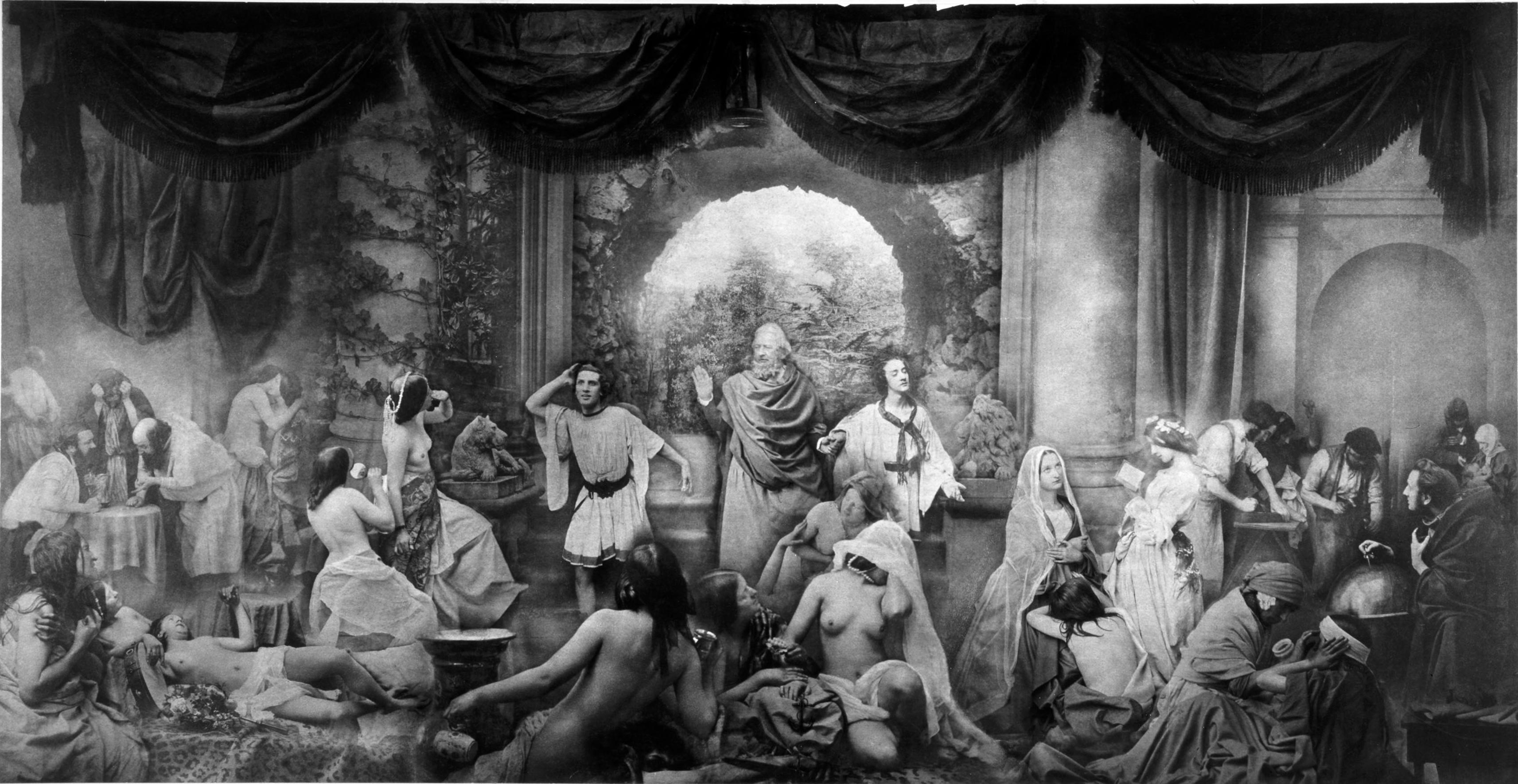
Two Ways of Life (1857) - Oscar Rejlander
The image I have chosen is an image by Oscar Gustave Rejlander. The image highlights a step forward in the skills and tricks of photography in the 19th century and also in a way the birth of art photography as a form. When first printed the image was about 31 inches and is made up of over 30 glass plate negatives, something that had not really been done before; the art of image manipulation started. To initially create the print he posed small groups next to each other and took the photograph. Once he had each separate negative he printed them one at a time onto a scroll of light sensitive paper, producing this highly skilled image, which depicts the different moral decisions that a young man faces and has to make. At the time this image was taken and created other photographic artists were at work to make art through image manipulation too. One of them being Henry Peach Robinson, on of his most noticeable pieces being ‘Fading Away’ (1858) in this image there is a scene depicting the death of a child – something which at this time was too familiar to people viewing the image. His image was again a photomontage but of only a few negatives, making it more believable. When people discovered the fact that the image had been constructed from multiple images they didn’t know what to believe and what not to believe – and so the argument of the photographic truth or rather the reality of images started.
In 1889 photography had its 50th anniversary, for this J. Wells Champney wrote an article summarising what photography had achieved in its fifty years, this covered: anthropology, science, society, military applications and technological advances. In it he says “As an aid to science, as a recorder, as a duplicator, photography has helped advance civilisation”. At the end of his article he stated how he believed that photography as an art form had not progressed as a normal art form should and towards the end of the 20th century more people came to agree with his point. One artist which refused the ideas of photography as an art form was Peter Henry Emerson who through his work was a strict naturalist and believed that the photograph should be what the camera captures and should not be edited and manipulated in any way. One of his most important theories was the ‘Naturalistic Photography’ theory. Emerson was so much so disgusted with the works of artists like Rejlander and Robinson that in 1890 he wrote a pamphlet on ‘The Death of Naturalistic Photography’. CARRY ON HERE TOMORROW
When I initially looked at this image I was not aware that it was made up of so many images, the first thing I thought about the image was the way it looks. The image is quite romantic; this is mainly because the image, at a distance and up close is very beautiful, exotic and emotional. Rejlander’s image draws the viewer in due to its size but also because you get the sense that you need to look at every part of the image to investigate further what is going on and what Rejlander is trying to say through his work.
When looking closely at all the different characters in the image you can clearly see how there are two young men, framed in the central third which appear to be looking in opposite directions. One young man is slightly less presentable in his dress sense and is listening out to the left side of the image which shows games, wine and naked women, which I would think for the date the image was created was a suggestion of prostitution. In contrast to this the young man who is listening out to the right hand side, dressed properly, looking over to the characters that are suggesting religion, work and education. Even though both sides of the image have nude figures on, the side with the religious figures have their faces covered, almost to suggest its just the beauty; in comparison to the nude figures on the left which appear to be sprawled out in a way. What I love about this image is that in a way it is almost timeless and could easily still be related to any century.
Triptychs, holy trinity where 'holy grail' figure is in the centre of the image with the 'two ways of life' either side.
Triptychs, holy trinity where 'holy grail' figure is in the centre of the image with the 'two ways of life' either side.
Sunday, 14 November 2010


Saturday, 13 November 2010
sailing...

Published with Blogger-droid v1.6.5
Tuesday, 9 November 2010
DEMO 2010

With less than a day until the demo the time to defend UAL is rapidly approaching.
With fees speculated to rise to £8,000 for Home/EU and up to £17,000 for International we cannot stand by and watch our ship sink. So it's time to man the deck, batten down the hatches and prepare for battle! Keep UAL afloat!
Join us as we march alongside your lecturers, tutors, technicians and well over 15,000 students nationally to defend university education from the potentially devastating measures the government want to push through. The latest revelation in our campaign is that students from the RCA have agreed to march alongside us in solidarity. Awesome!

Sunday, 7 November 2010
Ambitions

Self portrait 1.
Clive Roberts, 05/06/56
Clive Roberts, 05/06/64, Mechanic
Clive Roberts, 05/06/09, Financial Advisor
Right so... as my project progressed and after a few group crits there was suggestion that more contrast was needed in my images and they were too much 'to the point' SO to get around this I have taken to creating images of my family but with me in the images. I am going to create a series of self portraits where I become the people of my family. Simular to the works of Sherman - in contrast though the people she depicts in her work and of no relation and also the works of Dita Pepe have inspired my project. In her work she takes images with men and creates scenarios of what her life could be like if one thing was different. In my images I am portraying my family and their ambitions and job choices. Seeing whether through the generations the ideas of what they want to do changes or whether it is simular through the same family.
The basis of this image is that the background is the garage setting and the foreground is myself in a suit, dressed as my Father who is currently a financial advisor. The tools on the road signify the spannering of mechanics and the road is a symbol of how the choices could have been made. When taking the images I had the help of a photo-whizz friend but I chose the framing and then jumped in the picture. In my right hand is my remote - it wouldn't reach to the camera so I simply put it in my hand. I wanted there to be a clue as to that this was a self portrait.
Excuse my horrendous english.

Subscribe to:
Posts (Atom)