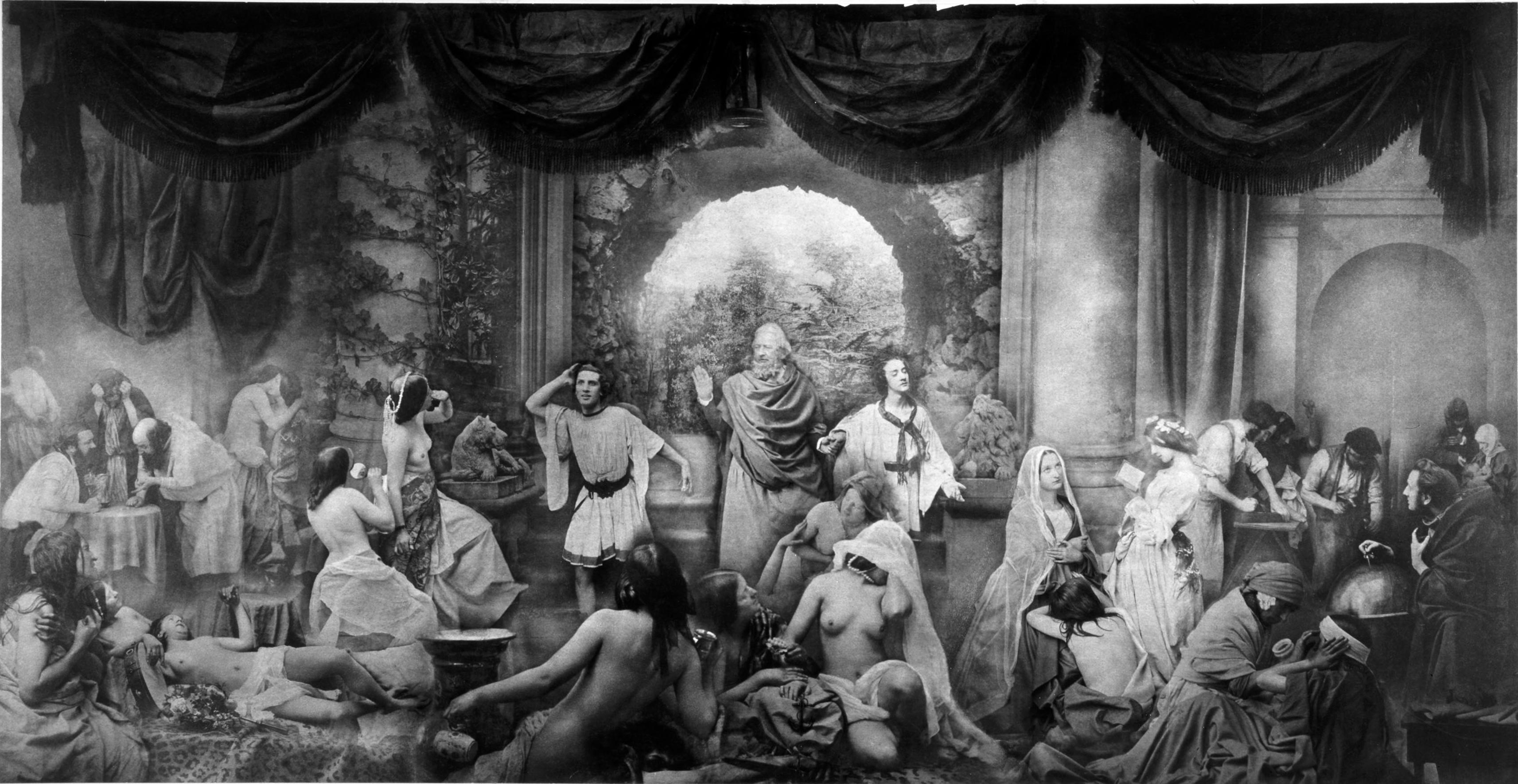
Two Ways of Life (1857) - Oscar Rejlander
The image I have chosen is an image by Oscar Gustave Rejlander. The image highlights a step forward in the skills and tricks of photography in the 19th century and also in a way the birth of art photography as a form. When first printed the image was about 31 inches and is made up of over 30 glass plate negatives, something that had not really been done before; the art of image manipulation started. To initially create the print he posed small groups next to each other and took the photograph. Once he had each separate negative he printed them one at a time onto a scroll of light sensitive paper, producing this highly skilled image, which depicts the different moral decisions that a young man faces and has to make. At the time this image was taken and created other photographic artists were at work to make art through image manipulation too. One of them being Henry Peach Robinson, on of his most noticeable pieces being ‘Fading Away’ (1858) in this image there is a scene depicting the death of a child – something which at this time was too familiar to people viewing the image. His image was again a photomontage but of only a few negatives, making it more believable. When people discovered the fact that the image had been constructed from multiple images they didn’t know what to believe and what not to believe – and so the argument of the photographic truth or rather the reality of images started.
In 1889 photography had its 50th anniversary, for this J. Wells Champney wrote an article summarising what photography had achieved in its fifty years, this covered: anthropology, science, society, military applications and technological advances. In it he says “As an aid to science, as a recorder, as a duplicator, photography has helped advance civilisation”. At the end of his article he stated how he believed that photography as an art form had not progressed as a normal art form should and towards the end of the 20th century more people came to agree with his point. One artist which refused the ideas of photography as an art form was Peter Henry Emerson who through his work was a strict naturalist and believed that the photograph should be what the camera captures and should not be edited and manipulated in any way. One of his most important theories was the ‘Naturalistic Photography’ theory. Emerson was so much so disgusted with the works of artists like Rejlander and Robinson that in 1890 he wrote a pamphlet on ‘The Death of Naturalistic Photography’. CARRY ON HERE TOMORROW
When I initially looked at this image I was not aware that it was made up of so many images, the first thing I thought about the image was the way it looks. The image is quite romantic; this is mainly because the image, at a distance and up close is very beautiful, exotic and emotional. Rejlander’s image draws the viewer in due to its size but also because you get the sense that you need to look at every part of the image to investigate further what is going on and what Rejlander is trying to say through his work.
When looking closely at all the different characters in the image you can clearly see how there are two young men, framed in the central third which appear to be looking in opposite directions. One young man is slightly less presentable in his dress sense and is listening out to the left side of the image which shows games, wine and naked women, which I would think for the date the image was created was a suggestion of prostitution. In contrast to this the young man who is listening out to the right hand side, dressed properly, looking over to the characters that are suggesting religion, work and education. Even though both sides of the image have nude figures on, the side with the religious figures have their faces covered, almost to suggest its just the beauty; in comparison to the nude figures on the left which appear to be sprawled out in a way. What I love about this image is that in a way it is almost timeless and could easily still be related to any century.
Triptychs, holy trinity where 'holy grail' figure is in the centre of the image with the 'two ways of life' either side.